I Was Convinced of Orthodoxy Long Before I Followed It
Why arguments weren’t enough, and what finally moved me.
Download the file for offline use
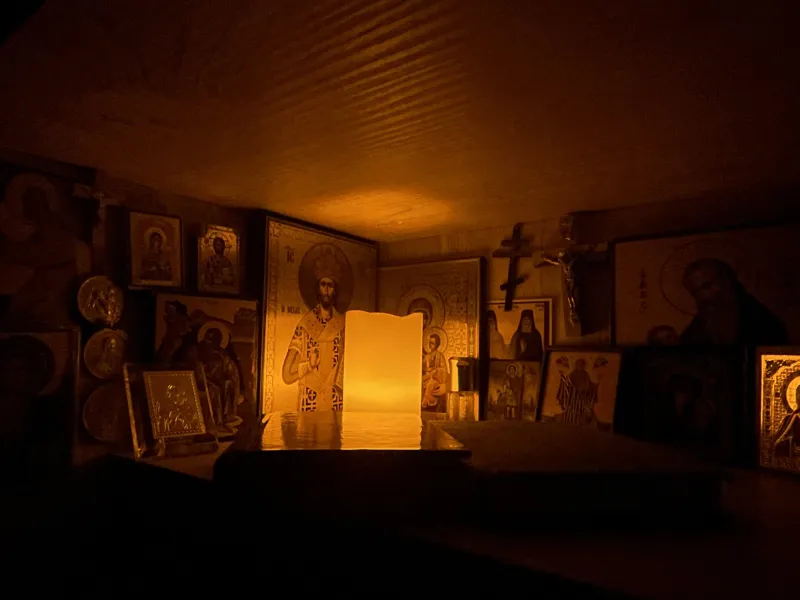
I was convinced of Orthodoxy long before I was willing to follow it. That was the strange part. The arguments made sense to me, and I couldn’t really refute them, but they didn’t move me. I stayed where I was, telling myself that it was “close enough,” that it didn’t really matter. And yet, no matter how much I tried to settle there, something in me remained unsettled.
Recently, a friend asked me, “What actually convinced you of Orthodoxy?” And I realized that the better question is not what convinced me, but what finally made it impossible for me to ignore it.
Part of the reason that question is difficult to answer is because my story didn’t begin with Orthodoxy at all. I grew up in the Roman Catholic Church here in the Philippines, and for most of my life, that was simply the air I breathed. When I first encountered Orthodoxy, it wasn’t through some dramatic experience, but through arguments: historical, theological, and philosophical. And to my surprise, I found them convincing.
But strangely, that didn’t lead to anything. I didn’t pursue it. I didn’t act on it. I told myself that what I already had was enough, that it was just another expression, another “lung” of the same faith. And yet, even as I tried to settle into that, I couldn’t quite shake what I had seen. The arguments stayed with me, quietly refusing to go away.
Looking back now, I realize that being convinced is not the same as being moved. And what I’m writing about here is not simply what convinced me, but what finally reached deeper than that.
Purpose and Meaning
At the time, my answer to life felt simple. I thought that if I improved myself, I would find direction, and in that direction, meaning. And if I could live well, I could help others, maybe even in some small way help the world.
It sounds reasonable. It even sounds noble.
But I was never satisfied with it. There was always something that bothered me, something I couldn’t quite ignore.
Now I realize, it was death.
Why does improving myself matter if, in the end, everything is swallowed by death? The good I do, the people I help, the life I try to build, doesn’t all of it eventually fade into nothing? What does it amount to if it cannot endure?
When I encountered Orthodoxy, I didn’t just find a better answer. I found that the question itself had been too small. It exposed the weakness in the modern answers I had believed, but more importantly, it pointed to something far deeper, something I had been looking for without even realizing it.
The Kingdom of God
I was looking for a kind of purpose and meaning that could survive death, something that would not dissolve when everything else dissolves. Something that was true not just for me, but for everyone. And if it was to be worthy of the name “meaning,” it had to be rooted in love, not the kind that fades with time or circumstance, but something more solid than the world I could see.
I thought I was searching for direction, for something to give my life shape and weight. But what Orthodoxy offered was not simply a better direction, it was a different kind of reality altogether.
In Orthodoxy, the purpose of life is not self-made meaning, nor the endless project of improving oneself until death finally interrupts the progress. It is something far more startling, and at the same time far more simple: to be united with Christ Himself. Not as an idea to admire from a distance, but as a real participation in His life. This is what the Church calls the Kingdom of God, not merely a place one reaches after death, but a reality that begins even now, quietly reshaping a person from within.
It began to take shape in small things, in prayer, in repentance, in the quiet struggle to love when it is easier not to.
And slowly, almost without me noticing at first, the question I had been asking began to change. It was no longer, “What will make my life meaningful before it ends?” but something deeper and more unsettling:
What does it mean to belong to Him at all?
Beauty
If that was the question, then the answer could not remain abstract. It had to be something lived. And so, almost without planning it, I found myself turning to the saints.
I began reading about saints from before the schism, Catholic saints after the schism, and Orthodox saints, especially those closest to our own time. At first, I wasn’t trying to prove anything. I was simply observing, trying to understand what a life that truly belongs to Christ looks like.
But over time, something became difficult to ignore.
It wasn’t just what the Orthodox saints said, it was how they lived, how they spoke, how they loved. There was a kind of continuity, a sameness of spirit that did not feel preserved, but alive.
I remember reading The Gurus, the Young Man, and Elder Paisios and not being able to put it down. There was nothing outwardly dramatic in the way St. Paisios of Mount Athos spoke, no grand displays, no attempt to impress. And yet everything about him seemed to carry a quiet, unmistakable presence. The way he forgave, the way he received people, the way he spoke, it was not merely admirable. It felt like Christ Himself was being reflected.
And I began to see the same thing elsewhere, in St. Gabriel Urgebadze, in St. Porphyrios of Kafsokalivia, in St. Silouan the Athonite. Different lives, different personalities, and yet the same light seemed to shine through all of them.
It is difficult to describe this as an argument, because it wasn’t one. It was something closer to recognition. There was a beauty in these lives that did not feel constructed or imitated, but received, something that could not be reduced to ideas or explained away.
And in the end, this was what I could not resist.
The arguments had convinced me. But they had not moved me.
This did.
It was not a matter of being persuaded, but of recognizing something I could no longer deny.
And in the end, it felt less like choosing Orthodoxy, and more like finding what my soul has always been searching for.